Architecture
Map Your Stripe Webhook Path: Where Can Billing State Break?
A useful payment architecture map makes trust, duplication, state ownership and recovery visible before customers discover the missing edge.
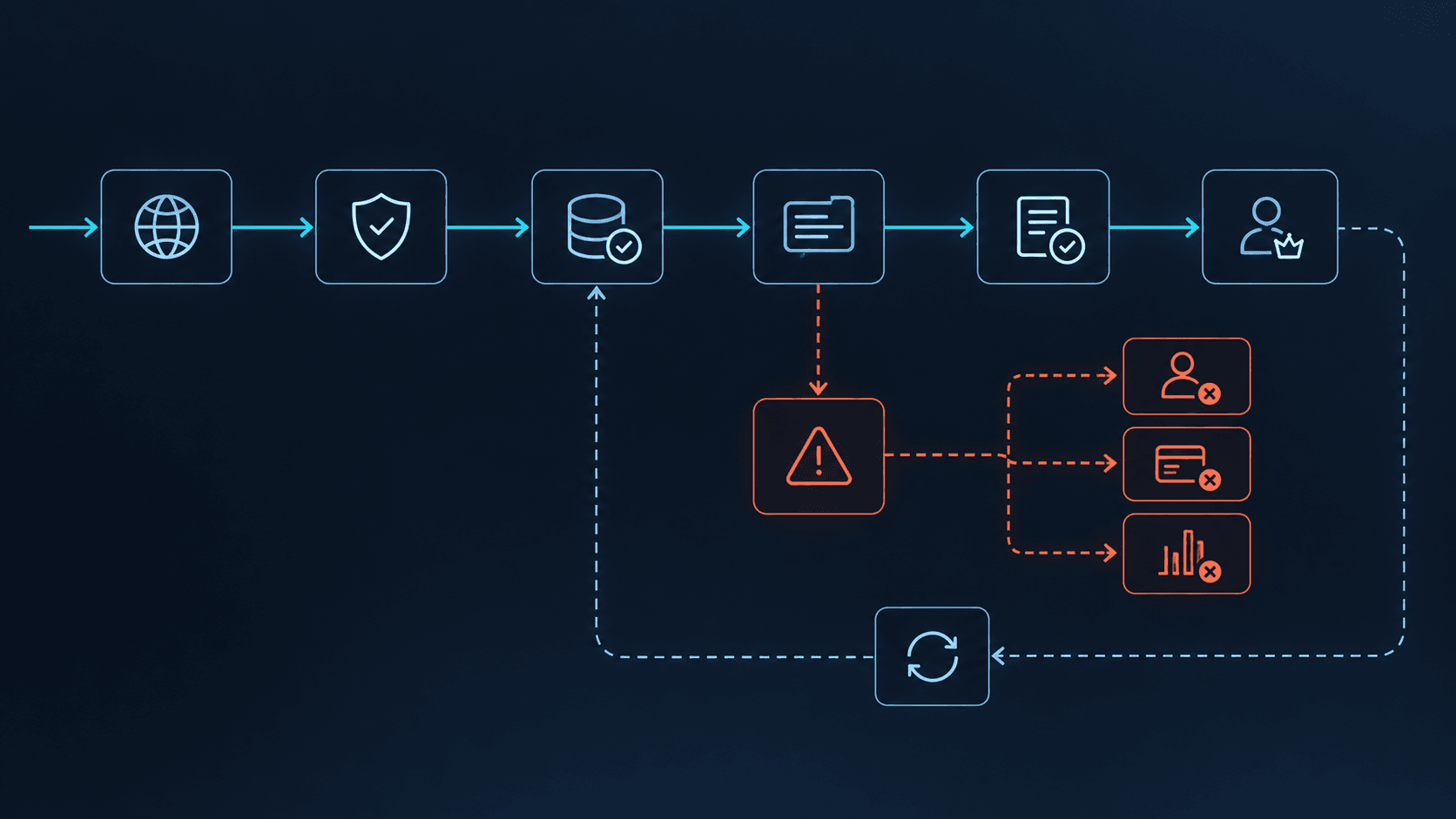

A Stripe button is not the interesting part of your payment architecture.
The interesting part begins after Stripe sends an event back to your system.
Draw the event path
The diagram exposes four questions that a successful checkout does not answer: trust, duplication, state transition and convergence.
Where the architecture can fail
1. Trust boundary
If the webhook handler accepts arbitrary JSON without verifying the Stripe signature, the event source has not been authenticated.
2. Duplicate boundary
If the same event ID can execute the same business mutation twice, a retry can become duplicate fulfilment, credits or side effects.
3. State boundary
If checkout redirects, webhook handlers and admin actions each write independent active flags, the application can create contradictory sources of truth.
4. Recovery boundary
If Stripe and your database disagree, there needs to be a path to detect and converge that state. Without one, the mismatch can persist until a customer notices.
What TenaxStack would look for
A useful architecture diagnostic would inspect for:
- public webhook endpoints connected directly to entitlement or order writes;
- Stripe handlers that parse an event but show no signature-verification step;
- absence of durable event-ID deduplication before non-idempotent mutations;
- multiple independent paths that can activate paid access;
- synchronous chains where a partial failure can happen after an external event is acknowledged;
- no retry/dead-letter/replay path where asynchronous processing exists;
- no reconciliation edge from payment provider state back to local billing state;
- client-side success pages that mutate authoritative paid state.
The point is not to flag every simple architecture as unsafe. It is to make the failure path visible.
Five diagnostic questions
- Which component proves the webhook came from Stripe?
- Where is the provider event ID made unique?
- Which component owns the authoritative entitlement transition?
- What happens if processing fails after receipt?
- What detects Stripe/local-state drift a day later?
If the diagram cannot answer those questions, the risk is architectural rather than cosmetic.
Sources
- Stripe AI webhook guidance
- 2026 builder discussion on subscription-state drift
- August 2026 AI integration verification discussion
What's next for you?
Sketch your payment event path as a graph rather than a checkout screen. Mark every place where trust is established, state changes, a retry can occur, and recovery happens. The missing edge is often the Production Gap.